
High-Throughput & AI/ML
The discovery of functional materials increasingly requires the exploration of large and complex parameter spaces. This is particularly true for high-entropy and compositionally complex materials, but also for functional inks, memristive materials and electrochemical systems, where composition, processing and structure can be varied over a wide range.
Our research therefore combines high-throughput synthesis and characterization with automated experimentation and AI/ML-assisted materials optimization. The aim is not only to identify promising materials efficiently, but also to establish meaningful composition–processing–structure–property–function relationships across complex materials spaces.
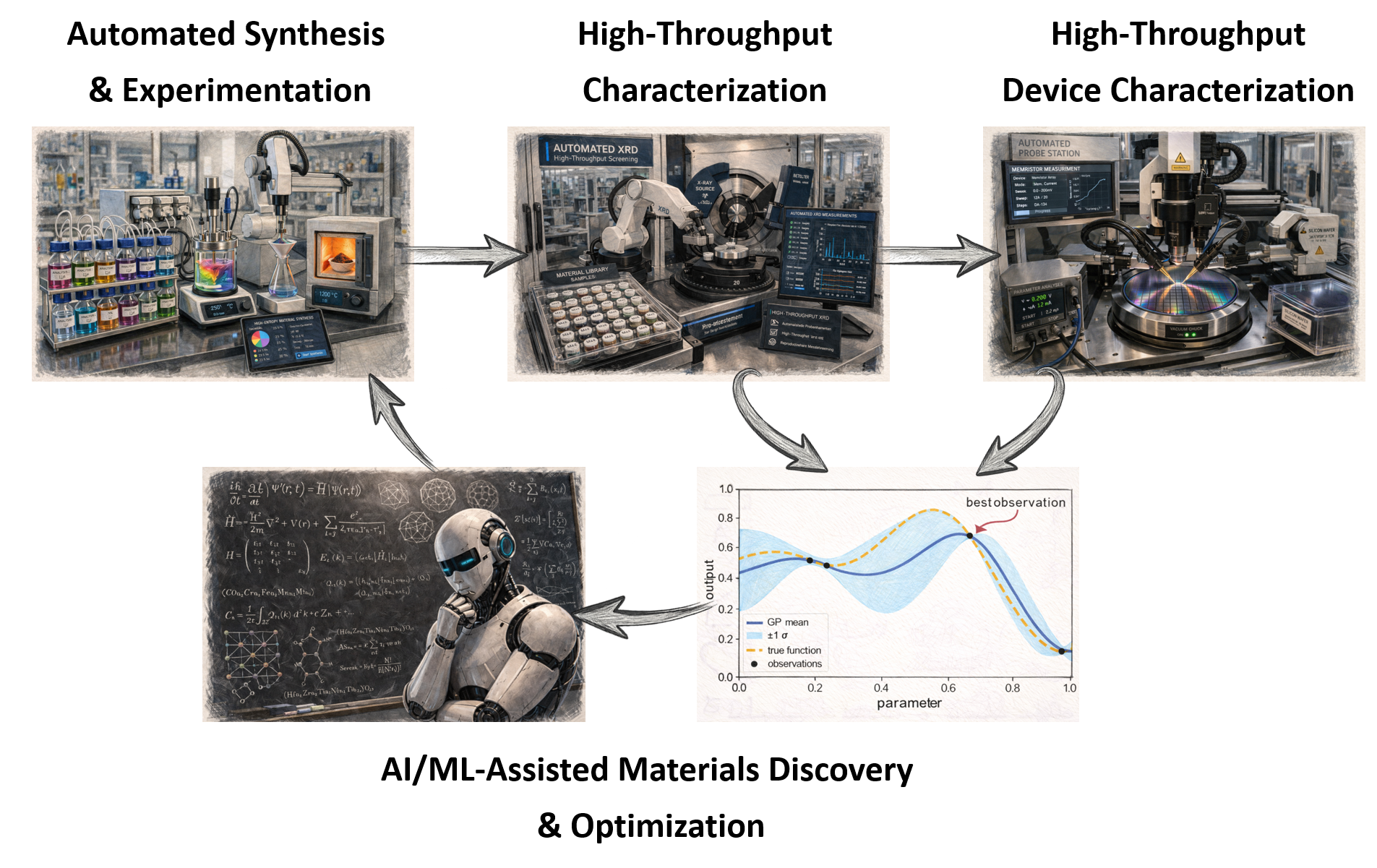
High-Throughput Materials Exploration
Conventional one-variable-at-a-time experimentation quickly becomes inefficient when many compositional and processing parameters must be considered simultaneously. High-throughput approaches allow us to investigate significantly larger materials spaces and to systematically compare large numbers of related samples under consistent experimental conditions.
Depending on the material system, we combine automated or parallelized synthesis with controlled thermal processing, thin-film deposition and solution-based fabrication. This enables systematic studies of parameters such as elemental composition, precursor chemistry, processing temperature, atmosphere and deposition conditions.
Automated Synthesis & Experimentation
Automation plays an important role in making large experimental campaigns reproducible and scalable. We develop experimental workflows in which synthesis, sample handling and subsequent measurements can be increasingly standardized and connected.
Our work includes automated and high-throughput wet-chemical synthesis as well as systematic processing of large sample libraries. Depending on the research question, these workflows are combined with thermal treatment, printing, thin-film deposition or other fabrication methods to generate materials libraries with well-defined variations in composition and processing history.
High-Throughput Characterization
Large materials libraries require characterization methods that can provide structural and functional information with similarly high throughput. We therefore combine automated and parallelized analytical techniques to rapidly identify phase formation, optical properties, electrochemical behavior and other relevant material characteristics.
Our high-throughput characterization capabilities include automated X-ray diffraction, optical spectroscopy and electrochemical screening. Depending on the material system, these techniques are complemented by more detailed structural, electrical and electrochemical measurements on selected samples.
This combination of broad screening and targeted in-depth characterization allows us to move efficiently from large compositional libraries toward a detailed understanding of the most relevant materials.
AI/ML-Assisted Materials Discovery
Machine learning and data-driven optimization provide powerful tools for navigating materials spaces that are too large to explore exhaustively. We use AI/ML methods to identify correlations in experimental datasets, compare materials across multiple descriptors and guide the selection of new experiments.
A particular focus lies on Bayesian optimization and related active-learning strategies. Instead of evaluating every possible composition or processing condition, these methods iteratively select experiments that are expected to provide the greatest information gain or the highest probability of improving a desired material property.
Importantly, data-driven optimization is not treated as an isolated black-box approach. Experimental data are combined with chemical and physical knowledge to understand why particular regions of a materials space exhibit favorable properties and which structural or chemical descriptors control the observed functionality.
From Screening to Closed-Loop Experimentation
By connecting automated experimentation, high-throughput characterization and algorithmic decision making, individual experimental steps can increasingly be integrated into iterative discovery workflows. Experimental results are analyzed, used to update a model and subsequently guide the next set of experiments.
Such approaches reduce the number of experiments required to identify promising materials and enable more efficient exploration of multidimensional parameter spaces. At the same time, they provide structured datasets that can be used to uncover general trends and improve the mechanistic understanding of complex functional materials.
Applications Across Our Research
High-throughput experimentation and AI/ML-assisted optimization are cross-cutting tools used throughout our research. They are particularly important for high-entropy and compositionally complex materials, where even modest numbers of elements can generate extremely large compositional spaces.
We apply these concepts to materials for electronic and electrochemical technologies, including memristive devices, functional inks, batteries, electrocatalysis and related functional materials. In each case, the objective is to combine efficient materials discovery with a fundamental understanding of how composition, structure, defects and processing determine functionality.