
Printed Electronics and Circuits

Keeping materials, devices, and circuits in one group means changes at the ink level can be evaluated against circuit performance directly, rather than assumed. Current projects range from electrolyte-gated transistors and printed memristors to crossbar arrays for neuromorphic computing and IC design on advanced CMOS nodes.
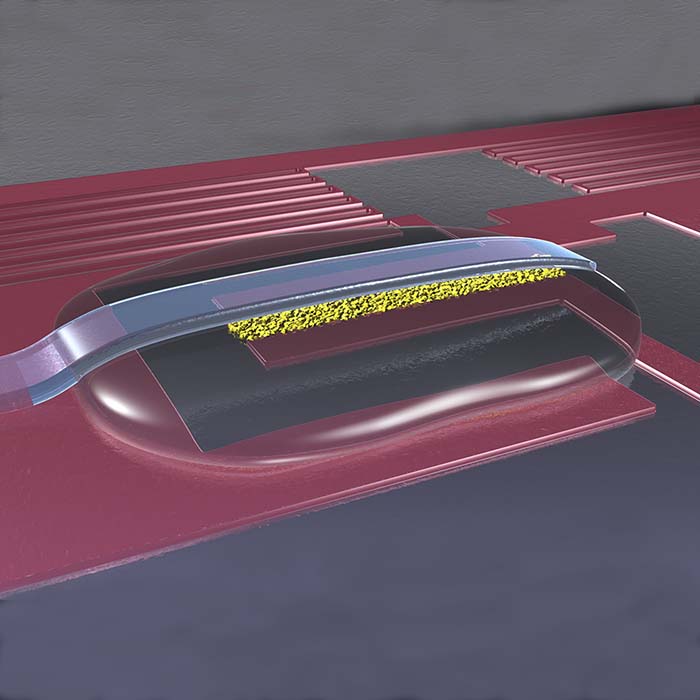
We develop printed electrolyte-gated transistors that operate at around 1 V, addressing device variability and switching speed.
linkUnder construction
Under construction
News
|
March 21nd, |
We are introducing in a tutorial, together with BASF, Cadence, and Innovation Lab, our joint work on developing a process design kit for organic transistors at the Date 2022 Conference. |
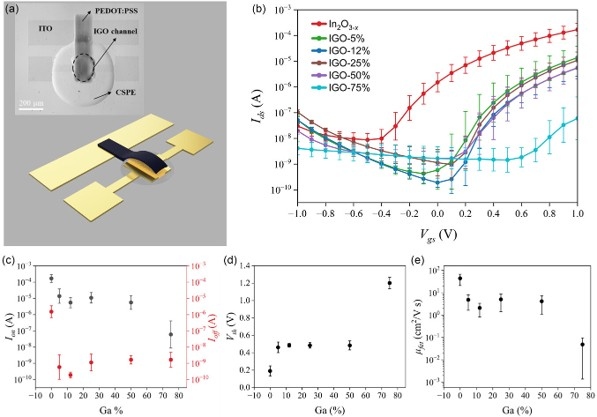
Water-based indium gallium oxide nanoparticle inks cure at just 100 °C, opening the door to flexible substrates. Adding gallium shifts the threshold voltage of printed electrolyte-gated transistors to 0.35 V and cuts off-currents by three orders of magnitude, enabling low-power inverters in both TRL and TTL topologies.
Physica Status Solidi (a)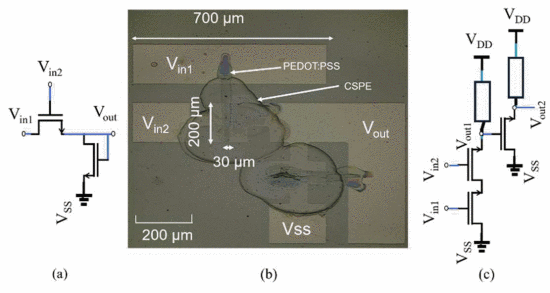
Pass logic-gates built from inkjet-printed electrolyte-gated transistors with indium oxide channels, operating at 1 V. Compared to conventional designs, the approach cuts transistor count by up to 60% and reduces propagation delay in printed digital circuits.
2024 IEEE International Flexible Electronics Technology Conference (IFETC)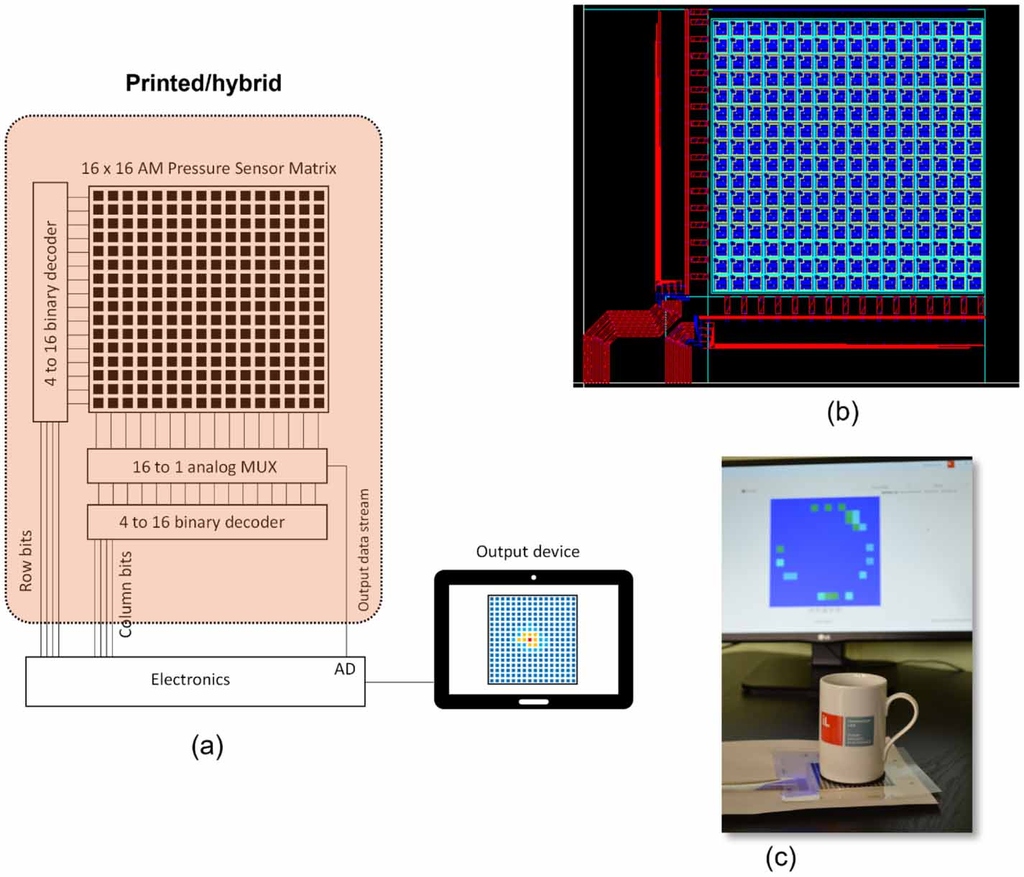
A process design kit for hybrid organic transistors, integrated into a commercial EDA tool, enables a full schematic-to-layout design flow for printed electronics. Using it, we built a 16 × 16 active-matrix pressure sensor with two printed 4 × 16 decoders on flexible foil, cutting wiring to the silicon periphery by a factor of four.
Flexible and Printed Electronics
An inkjet-printed tungsten oxide memristor that serves as either non-volatile digital memory or an artificial synapse, selected by the presence or absence of an electroforming step. It shows record endurance for a printed memristor alongside plasticity and signal filtering on biological timescales.
Advanced Functional Materials
Printing resolution normally sets the floor on how short a printed transistor channel can be. We get around it by laser-writing a 3D polymer reservoir whose platinum-coated inner walls act as the drain and source electrodes, confining the printed indium oxide channel to a 3 µm gap and forming a vertical contact that improves the electrode-semiconductor interface.
Advanced Materials Technologies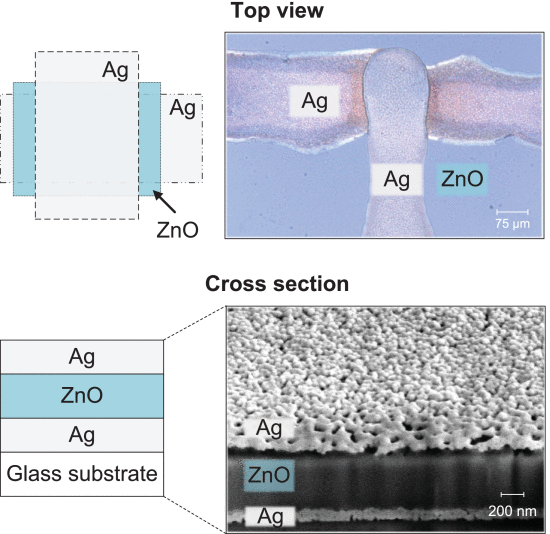
A fully inkjet-printed Ag/ZnO/Ag memristor that switches with a single voltage polarity, unlike every other printed metal oxide memristor reported so far. The unipolar behaviour simplifies the peripheral circuitry needed for crossbar integration, and the device holds an ROFF/RON ratio of 10⁷ over 100 pulsed cycles with retention beyond 10⁴ s.
IEEE Transactions on Electron Devices