
Memristive Materials & Devices
Memristive devices are strongly governed by the properties of their active materials. Our research therefore takes a materials-driven approach to resistive switching, aiming to understand how composition, structure, defects, interfaces and processing determine device behavior.
We develop and investigate novel active materials for both digital and analog memristive devices. Particular emphasis lies on identifying the microscopic processes responsible for switching and establishing direct relationships between material properties, switching mechanisms and device performance.
Materials & Switching Mechanisms
Resistive switching often involves complex interactions between electronic transport, ion migration, defect redistribution and interfacial processes. We investigate how these mechanisms are influenced by material composition, defect chemistry, local structure, electrode interfaces and processing history.
A central goal is to understand the formation, modification and rupture of conductive pathways and to identify which material parameters determine switching voltage, resistance states, variability, endurance and retention. By correlating electrical behavior with material properties, we aim to move from empirical device optimization toward a mechanistic understanding of resistive switching.
Digital & Analog Memristors
Digital Switching
Digital memristive devices rely on reproducible switching between distinct high- and low-resistance states. We investigate how active-material composition and device structure influence SET and RESET processes, switching voltages, resistance contrast, endurance, retention and device-to-device variability.
Understanding these relationships is essential for the development of robust non-volatile memory devices and provides insight into the underlying ionic and electronic processes governing filamentary or interface-driven switching.
Analog Switching & Neuromorphic Computing
Analog memristors allow the conductance of a device to be tuned gradually rather than switching only between two discrete states. This behavior is particularly interesting for neuromorphic computing, where continuously adjustable conductance states can emulate synaptic weight updates.
We investigate how material properties control parameters such as linearity, symmetry, dynamic range, state stability and cycle-to-cycle reproducibility. Our goal is to identify material design strategies that enable controlled and reproducible analog switching behavior.
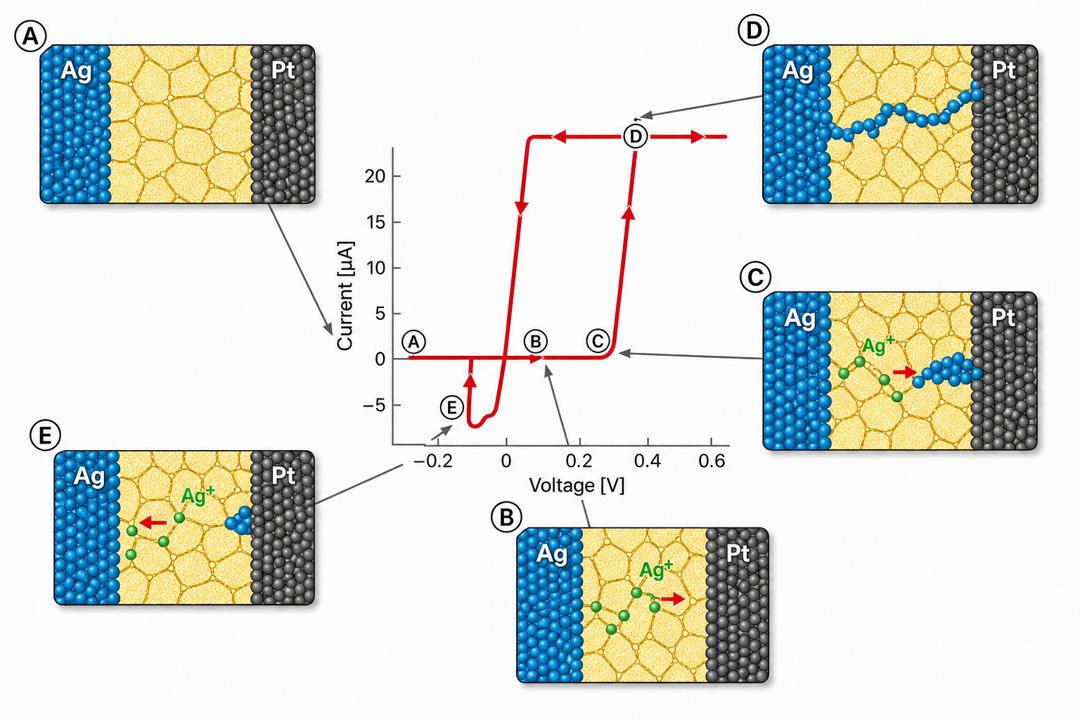
adapted from: Ilia Valov et al., 2011, Nanotechnology, 22, 254003
Material Platforms & Processing
Our research covers different classes of active materials, including metal oxides, compositionally complex and high-entropy materials, metal-organic frameworks and nanoparticle-based systems. These material platforms provide complementary opportunities to tune defect chemistry, ion transport, electronic conductivity and local chemical environments.
Depending on the scientific question and material system, active layers are fabricated using solution-based and thin-film techniques such as printing, pulsed laser deposition and sputtering. This allows us to systematically study how synthesis and processing influence microstructure, interfaces and resistive switching behavior.
Characterization & Mechanistic Understanding
Electrical characterization is combined with structural, electrochemical and impedance-based methods to obtain a detailed understanding of device operation. We investigate current–voltage characteristics, switching statistics, endurance, retention and analog behavior, together with impedance and transport properties.
Where appropriate, these measurements are complemented by structural and chemical characterization to correlate electrical behavior with changes in the active material and at the electrode interfaces. This combined approach helps us distinguish between competing switching mechanisms and identify the material parameters that control device performance.
High-Entropy Materials for Memristive Devices
High-entropy and compositionally complex materials provide a particularly promising platform for controlling defect landscapes, ion transport and local chemical environments in memristive devices. Their large compositional design spaces offer new opportunities to systematically tune switching behavior beyond conventional binary or ternary materials.
We therefore explore high-entropy oxides and high-entropy MOFs as emerging active materials and investigate how chemical complexity influences resistive switching, device stability and neuromorphic functionality.
→ High-Entropy & Compositionally Complex Materials