High Entropy & Compositionally Complex Materials
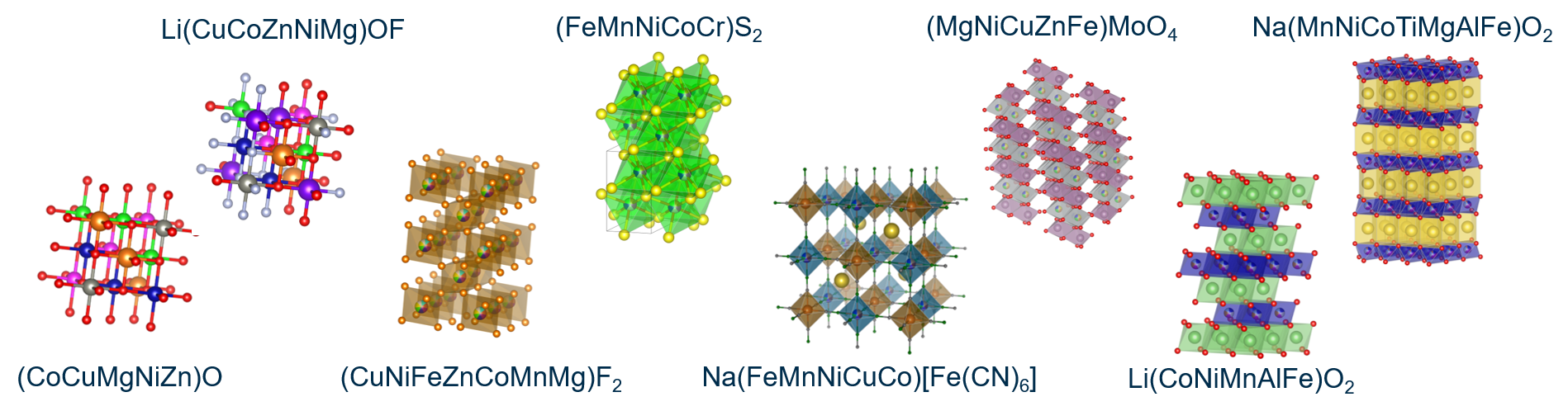
High-entropy and compositionally complex materials offer exceptionally large compositional design spaces for tailoring functional properties. We investigate how composition, local structure, defects and processing influence electronic, ionic and electrochemical behavior.
Our aim is to establish fundamental composition–structure–property–function relationships and use them to design materials for emerging electronic and energy technologies. Rather than considering configurational entropy as an isolated design parameter, we view chemical complexity as a versatile platform for systematically tuning structure, defects and functionality.
Material Classes

High-Entropy Oxides
We investigate compositionally complex oxides with different crystal structures and focus on the interplay between phase formation, defect chemistry, local distortions and functional properties. Particular interest lies in understanding how the simultaneous presence of multiple cations modifies lattice stability, local chemical environments and transport processes.
These effects can strongly influence electronic and ionic conductivity, redox behavior and switching mechanisms. We therefore explore high-entropy oxides as active materials for memristive devices, electrochemical systems and other emerging electronic and energy applications.
High-Entropy Metal-Organic Frameworks
High-entropy MOFs combine compositional complexity with structurally defined and porous frameworks. By incorporating several metal species into a common framework, it becomes possible to vary local coordination environments, redox properties and host–guest interactions while largely retaining the underlying structural motif.
We investigate how this local chemical complexity influences ion interactions, transport, electronic properties and framework functionality. Current research includes high-entropy MOFs for electrochemical applications and as active materials in printed memristive devices.
Prussian Blue Analogues and Other Complex Materials
Compositionally complex Prussian blue analogues provide another highly tunable platform in which multiple transition-metal species can influence redox chemistry, ionic transport and electronic functionality. Their open framework structures are particularly attractive for studying the coupling between composition, charge transfer and ion motion.
Beyond oxides, MOFs and PBAs, we also explore other multicomponent material classes whenever chemical complexity offers promising routes toward new or tunable properties. This allows us to transfer concepts across different structural and chemical systems rather than restricting our research to a single family of materials.
High-Throughput & AI/ML-Assisted Materials Discovery
The large composition spaces of multicomponent materials require efficient exploration strategies. Even systems containing only a limited number of elements can generate very large numbers of possible compositions, making conventional trial-and-error approaches increasingly inefficient.
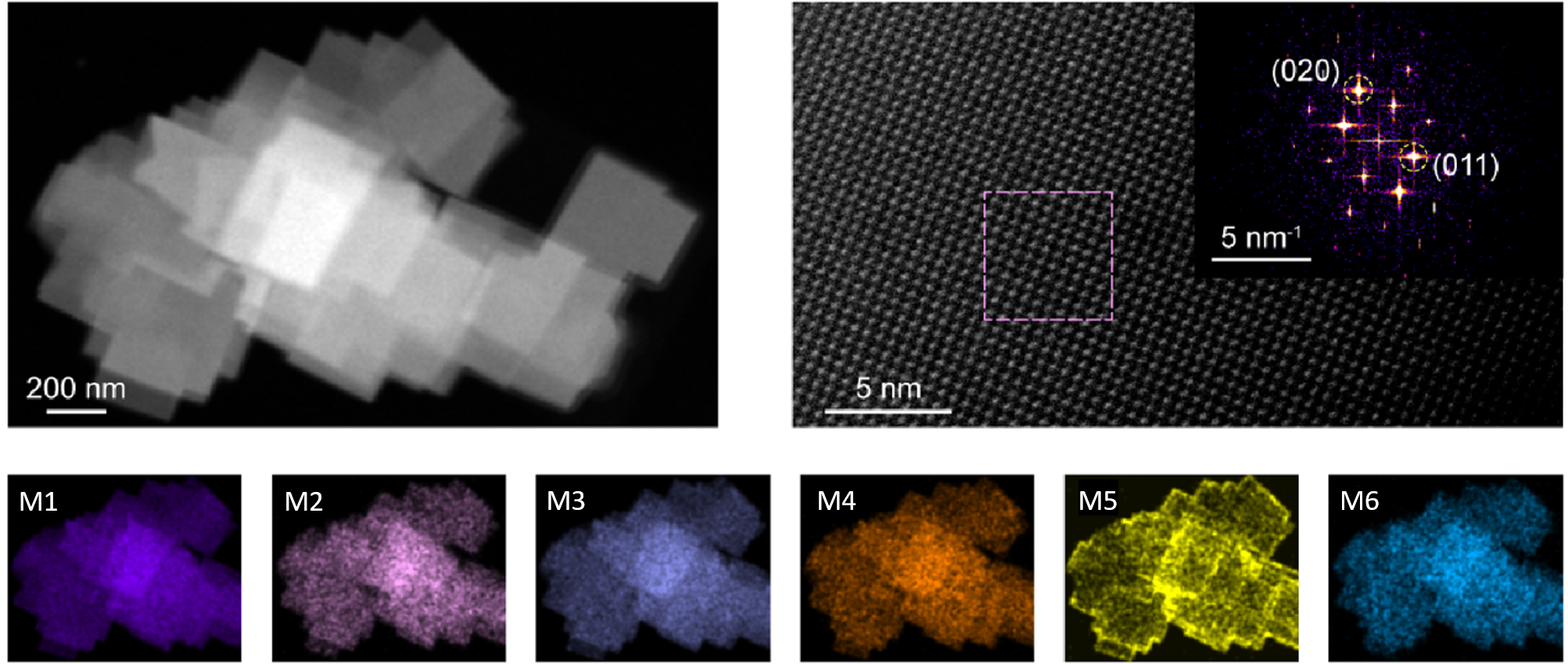
We therefore combine automated synthesis, high-throughput characterization and AI/ML-based optimization to identify promising compositions and guide subsequent experiments. Structural, optical and electrochemical data can be generated across large sample libraries and used to uncover composition–property relationships.
Bayesian optimization and related data-driven methods allow us to focus experimental effort on the most informative regions of compositional space. Our long-term goal is to establish increasingly autonomous materials-discovery workflows in which synthesis, characterization, data analysis and optimization form an iterative cycle.
Functionalities & Applications
Memristive Materials
High-entropy and compositionally complex materials provide new opportunities to control defects, ionic migration and electronic transport in resistive switching devices. These processes are central to the formation, modification and rupture of conductive pathways and therefore directly influence device behavior.
We investigate their use as active materials in digital and analog memristors, with particular interest in neuromorphic computing. A central goal is to understand how composition, local structure, interfaces and processing determine switching voltages, resistance states, endurance, retention and analog switching behavior.
→ Memristive Materials & Devices
Electrochemical Functionalities
We investigate how compositional complexity affects redox processes, ion transport and interfacial reactions in electrochemical systems. Multicomponent materials offer the possibility to tune several relevant properties simultaneously, including redox potentials, defect chemistry, transport pathways and surface reactivity.
Current and future research directions include batteries, electrocatalysis and other energy-related functionalities. Our focus lies not only on improving performance, but also on understanding which compositional and structural features control the underlying electrochemical processes.
High-Entropy Research at INT
High-entropy materials research at INT is embedded in a broader interdisciplinary environment that connects materials synthesis, high-throughput experimentation, advanced characterization, electronic devices and data-driven materials discovery.
Our activities are strengthened by close interaction with the Junior Research Group of Dr. Simon Schweidler, which focuses on high-entropy materials for catalytic applications and combines high-throughput experimentation with data-driven optimization. Together, these complementary activities create a broad research platform for exploring compositionally complex materials across different structures and functionalities.
→ High-Entropy Catalysts MAP-KAT – Simon Schweidler Group