
Junior Reseach Group | Simon Schweidler
Project Description
Innovative Materials Acceleration Platform for Tailored Catalysts for Electrochemical Water Splitting (MAP-KAT)
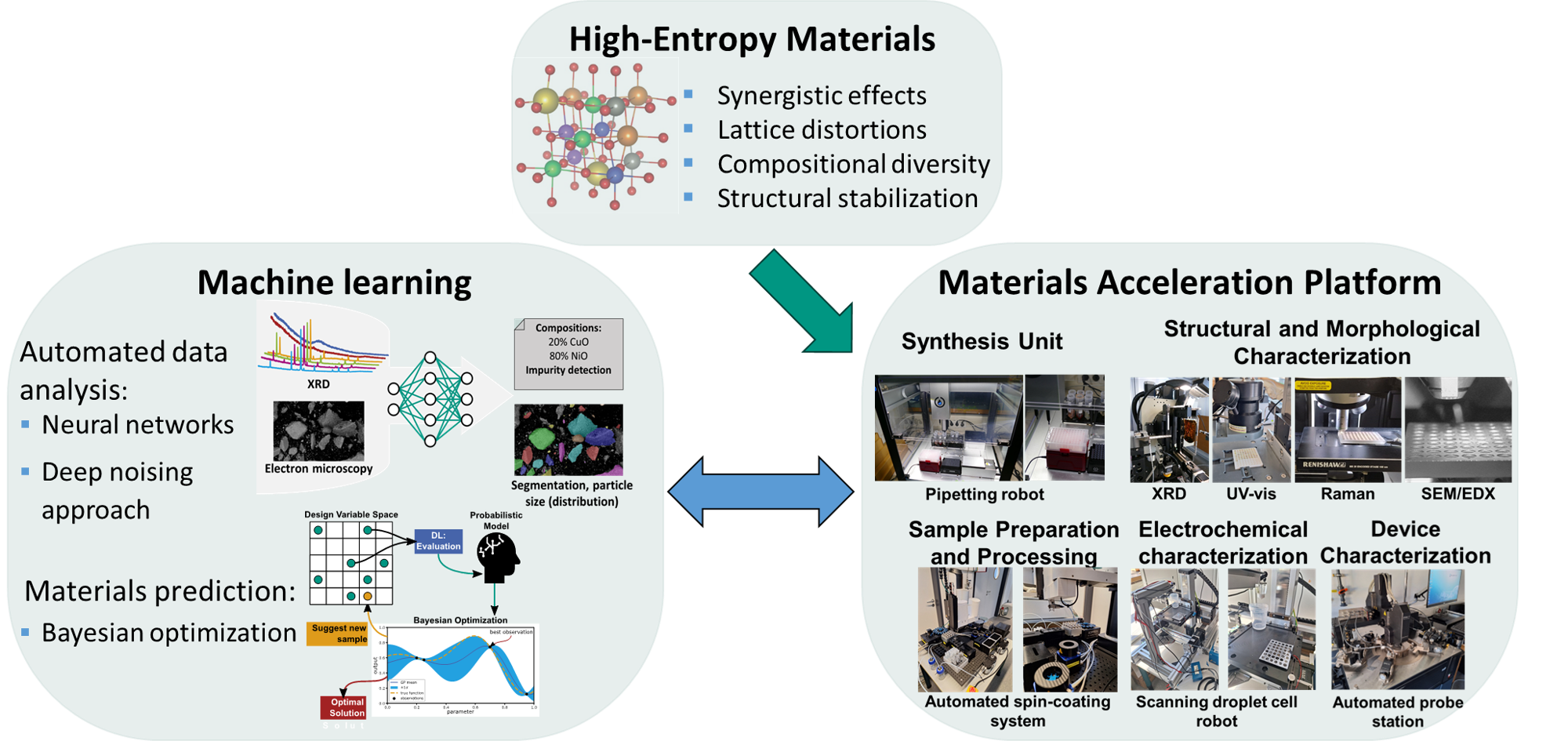
The MAP-KAT group develops high-entropy catalyst materials for efficient and durable electrochemical water splitting. By combining high-throughput experimentation with machine learning, we accelerate the discovery of next-generation catalysts for sustainable hydrogen production.
The production of green hydrogen is a key technology for reducing greenhouse gas emissions and enabling a sustainable energy transition. Hydrogen serves as a clean and versatile energy carrier for industry, mobility, and large-scale energy storage. To make electrochemical water splitting economically viable at scale, highly efficient and durable catalyst materials are required.
The MAP-KAT group focuses on the development of next-generation catalysts that enhance both the efficiency and long-term stability of water-splitting reactions. Our research centers on high-entropy materials (HEMs) - multicomponent systems composed of five or more principal elements derived from abundant and cost-effective resources. Owing to their complex elemental interactions, HEMs exhibit unique cocktail effects, which can lead to increased electrical conductivity, a high density of active catalytic sites, and improved structural and electrochemical stability.To navigate the vast compositional space of HEMs, an materials acceleration platform is used. This platform combines high-throughput synthesis, automated materials characterization, and electrochemical testing. The resulting datasets are analyzed using machine learning and artificial intelligence, enabling the rapid identification of promising catalyst compositions, targeted optimization of synthesis parameters, and data-driven prediction of high-performance materials.Selected catalysts are investigated in depth to establish fundamental structure–property–performance relationships. In parallel, systematically designed material libraries are created, providing a versatile foundation not only for water-splitting catalysis but also for related applications such as energy storage, photocatalysis, and sensing.
Overall, the group aims to develop efficient, durable, and scalable high-entropy catalysts. By combining advanced materials design with data-driven discovery, the group contributes to sustainable hydrogen production and supports Germany’s transition toward a climate-neutral energy system.
Funding
Team members
- M.Sc. Robert Wang (PhD candidate)
- M.Sc. Lukas Becker (PhD candidate)
Publications
https://scholar.google.com/citations?user=AScSUpUAAAAJ&hl=de
https://www.researchgate.net/profile/Simon-Schweidler