Virtual Design of Soft Matter and Natural Materials
The DNA Unit of Virtual Materials Design platform (DNA VirtMat Unit) within Center SynGen is led by Dr. Mariana Kozlowska. Her group "Virtual Design of Soft Matter and Natural Materials" focuses on supramolecular, coordination and biomolecular assemblies, as well as natural systems, by modeling the structure, organization, properties, and interactions of molecules using scale-bridging computational approaches. Within the Center SynGen, the group builds virtual pipelines for DNA organization, simulation, and analysis, as well as nucleosome and chromatin modeling, toward a mechanistic understanding of genome organization and the rational design of novel DNA-containing materials for nanomaterial technologies.
The overarching aim of the DNA VirtMat Unit is to advance synthetic genomics through in silico genome analysis, sequence design, and multiscale modeling of DNA and chromatin, thereby guiding the synthesis of functional DNA sequences.
Structural Dynamics of the Centromeric Nucleosomes
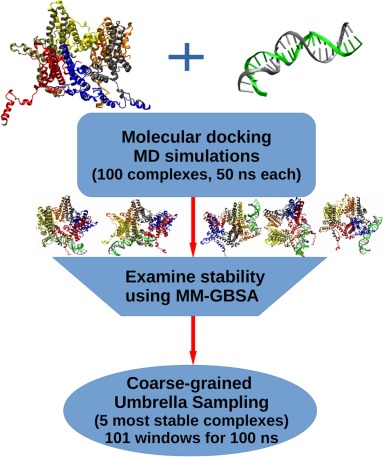
The organization of DNA into chromatin is fundamental for genome function and regulation. Within the Center SynGen, our research combines multiscale molecular simulations with structural biology to uncover how sequence-dependent DNA mechanics and protein interactions regulate centromeric chromatin. We use coarse-grained and atomistic computational models to investigate the dynamic behavior of nucleosomes and their interactions with centromere-specific proteins.
Structural dynamics in the CENP-A nucleosome impacted by protein–protein interactions with centromere protein N
-
Author:
Abhik Ghosh Moulick; Sylvia Erhardt; Wolfgang Wenzel; Mariana Kozlowska
-
Source:
Nanoscale (2026)
- Date: 10 June 2026
-
This work demonstrates that CENP-N binding induces long-range allosteric communication within the CENP-A nucleosome. Rather than acting only at its binding interface, CENP-N modulates histone–DNA interactions, stabilizes the CENP-A RG loop, enhances the flexibility of the CENP-A N-terminal region, and reshapes the conformational landscape of CENP-A while leaving the overall nucleosome architecture largely unchanged. These findings reveal how localized protein binding can propagate dynamic changes across the nucleosome through allosteric mechanisms.

DNA Sequence-Encoded Molecular Interactions
DNA sequence defines not only the genetic information but also the thermodynamic and structural landscape governing molecular recognition, folding, self-assembly, and biomolecular interactions. Within this project, we investigate and predict how intra- and intermolecular interactions shape secondary structure formation, hybridization pathways, structural organization, and interactions of DNA with proteins and other molecules.
Impact of DNA on interactions between core proteins of Hepatitis B virus-like particles comprising different C-terminals
-
Author:
Srdjan Pusara, Wolfgang Wenzel, Mariana Kozlowska
-
Source:
International Journal of Biological Macromolecules
- Date: April 2024
-
This study employs coarse-grained molecular dynamics and free-energy calculations to investigate the interplay between protein-protein and protein-DNA interactions during the assembly of hepatitis B virus-like particles. It demonstrates how the length of the nucleic acid-binding domain modulates assembly stability and DNA-mediated stabilization, providing molecular insights for the rational engineering of VLP-based gene delivery systems.
DNA Sequence-Controlled Functional Materials
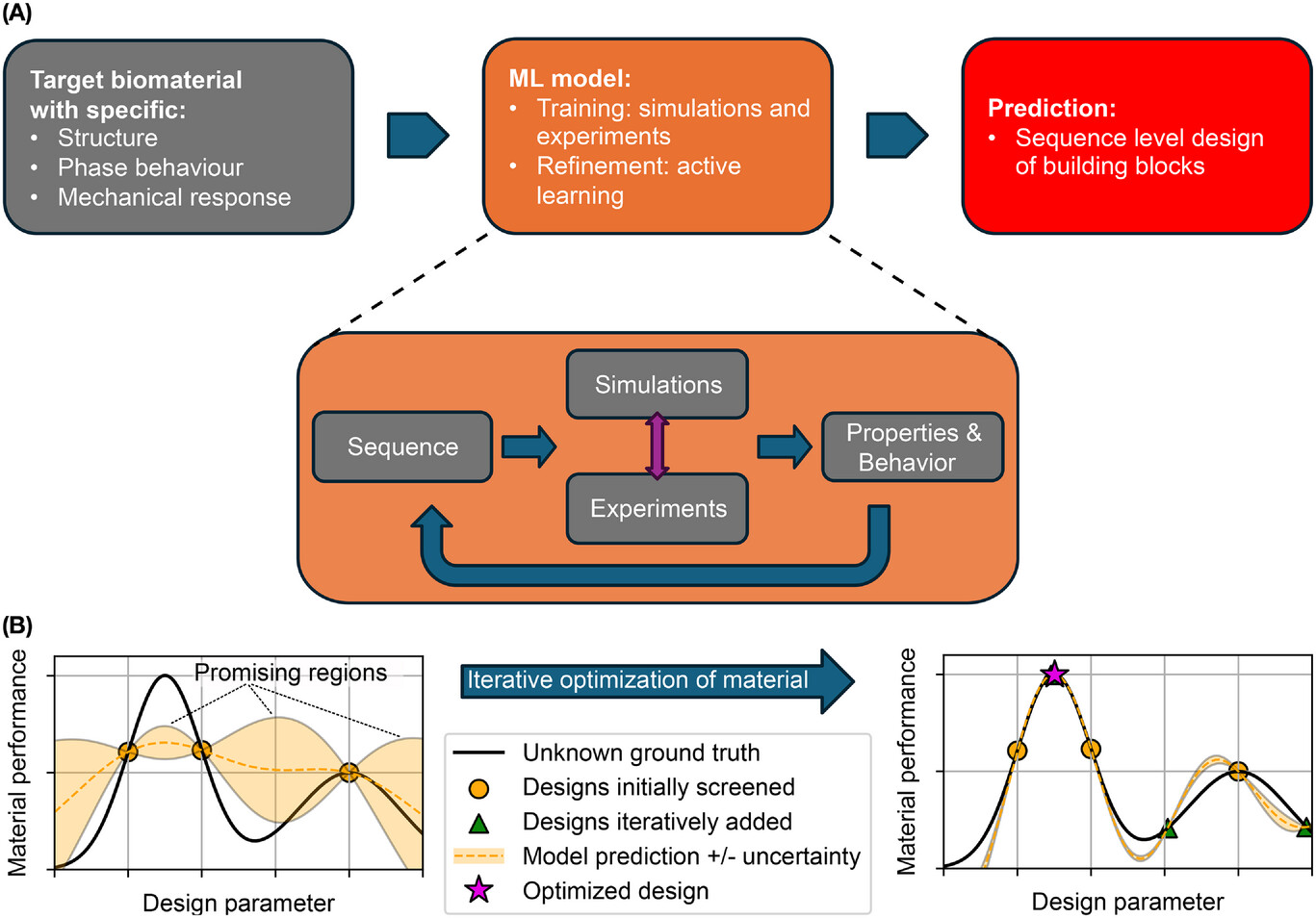
DNA carries a symbolic code that can be used to program the functional properties of DNA-based materials. Effective programming, however, requires understanding how DNA sequence alterations give rise to emergent material properties across multiple length scales. Within this project, we investigate how DNA-sequence-encoded nanomotifs assemble into higher-order networks and how this hierarchical organization governs sequence-property relationships in programmable DNA materials.
Integrative Approaches for DNA Sequence-Controlled Functional Materials
-
Author:
Aaron Gadzekpo, Ewa Anna Oprzeska-Zingrebe, Mariana Kozlowska, Lennart Hilbert, Iliya D. Stoev
-
Source:
Advanced Functional Materials - Volume 36, Issue 18
- Date: 07 November 2025
-
This perspective article discusses how integrative computational, experimental, and machine-learning approaches can bridge DNA sequence design with the emergent properties of functional materials composed of DNA nanomotif networks with sequence-encoded interaction sites. It highlights computational frameworks and experimental strategies required to characterize and engineer these complex systems across multiple length scales.
Computational Method Development
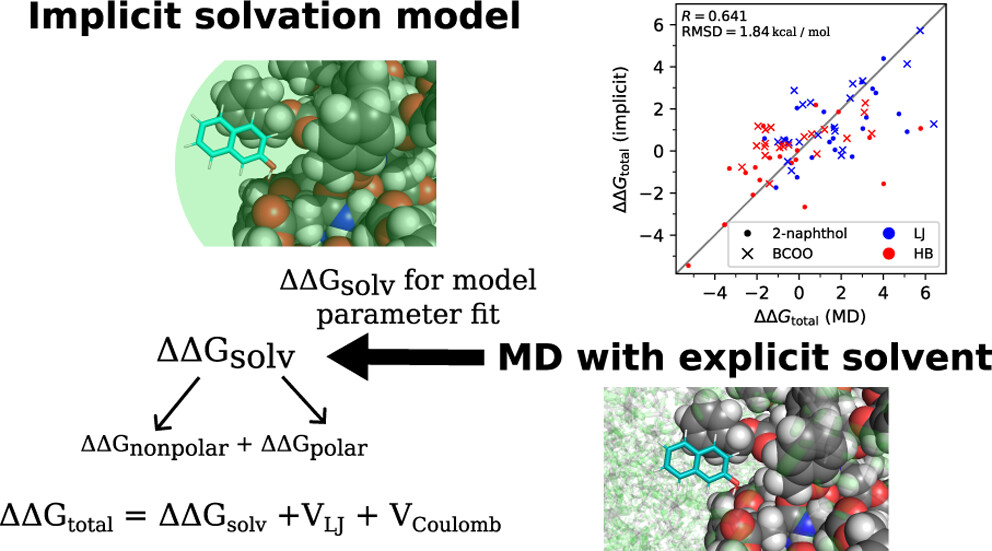
We develop physics-based models, multiscale algorithms, and efficient simulation techniques for molecular interactions, free-energy estimation, and biomolecular modeling that support applications across DNA nanotechnology, biomolecular recognition, and synthetic biology. Publicly accessible codes are available here.
An Implicit Solvation Model for Binding Free Energy Estimation in Nonaqueous Solution
-
Author:
David Elsing, Wolfgang Wenzel, Mariana Kozlowska
-
Source:
The Journal of Physical Chemistry B - Vol 129/Issue 6
- Date: January 29, 2025
-
This work presents a computationally efficient implicit solvation model for binding free-energy estimation in nonaqueous environments. The developed methodology enables rapid prediction of molecular interaction energies while maintaining agreement with explicit-solvent molecular dynamics simulations, providing a foundation for scalable sampling and molecular design workflows.