
Immunoassay Fabrication and Device Functionalization by Scanning Probe Lithography
-
Author:
S. K. Vasantham, G. Mathew, H.-Y. Liu, M. Saghafi, W. Yang, W. Wang, N. Hussain, M. Hirtz
-
Source:
Immunoassays, A. M. Raem, P. Rauch (eds.) Springer, Berlin, Heidelberg (2026) 435-447
- Date: 2026
-
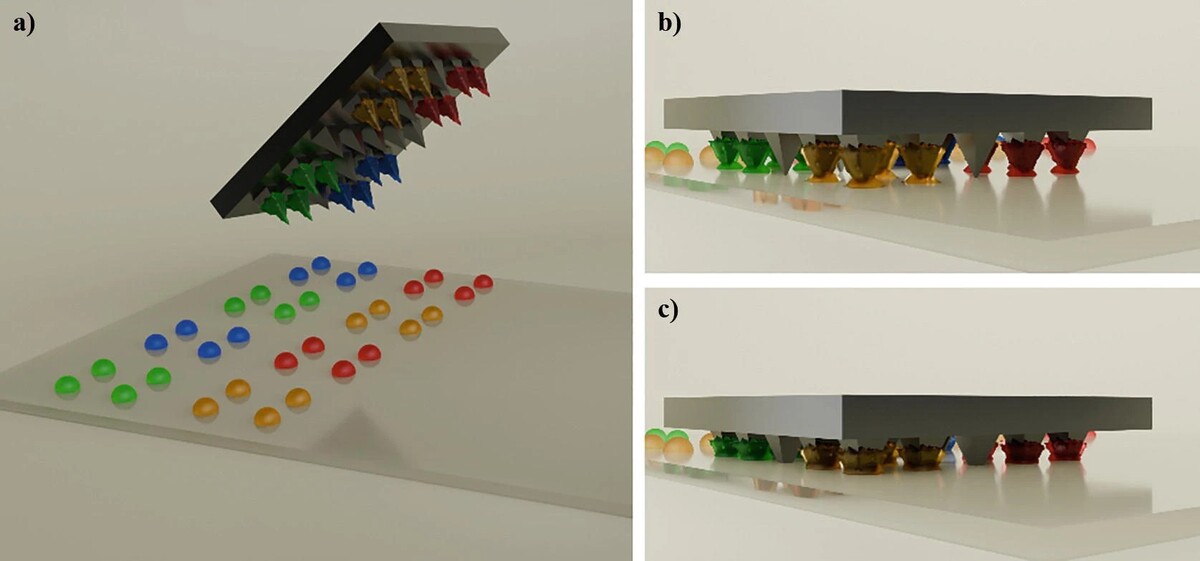
In this chapter, we describe scanning probe lithography (SPL) techniques (a diverse set of techniques, including dip-pen nanolithography (DPN), polymer pen lithography (PPL), microchannel cantilever spotting (μCS), and microcapillary printing (MCP), among others) with a special focus on applications involving deposition of antibodies. Generally, these methods utilize a probe or an array of probes scanned over a surface to deliver materials (“inks”) or introduce energy for material modification. They typically employ an atomic force microscopy (AFM)-like setup with nanometer-scale positioning precision. Unlike conventional lithographic techniques such as photolithography or electron beam lithography, SPL operates under mild conditions, avoiding vacuum environments and harsh chemical treatments. This makes SPL particularly suitable for patterning delicate biomaterials while enabling mask-free, multiplexed, and direct-write surface functionalization. These features position SPL as a powerful tool particularly also for applications such as immunoarray fabrication and biomaterial deposition on sensor devices. Future advancements will likely involve integrating SPL with traditional lithographic techniques, leveraging the advantages of both to create hybrid systems. This approach can enable precise functionalization of semiconductor structures with biomolecules, facilitating highly localized and on-demand modifications. The synergy between SPL and conventional lithography presents a promising avenue for advancing biosensors, biomedical devices, and biofunctionalized surfaces.