
Scanning Probe Lithography for Biomaterials and Bioelectronics
 Our research is aimed at the advancement and application of Scanning Probe Lithography (SPL) methods, in particular Dip-Pen Nanolithography (DPN) and related methods like e.g. Polymer Pen Lithography (PPL) and Microchannel Cantilever Spotting (µCS).
These SPL methods are versatile tools, combining many advantages of electron beam lithography, inkjet printing and microcontact printing in relation to resolution, integration and throughput. These methods are of particular interest when working with sensitive biological materials, since they work at mild process parameters and need no lift off processes (with the associated solvents or etching processes). Furthermore, the methods allows for "multiplexing", i.e. the parallel application of different inks within a pattern. Learn more about specific implementations and applications on our reseach page or browse our publications.




"Polyoxometalate@Metal–Organic Framework-Based Imprinted Electrochemical Sensor for Dopamine Detection" by Wang et al. in Small Sci. 6 (2026) e70380
more
We welcome Kaan Yapici in our group!

"Comparative kinetics of CuAAC and thiol–yne click chemistries for high-density streptavidin immobilization on alkyne-terminated glass surfaces" by Dadfar et al. in Surf. Interfaces. 98 (2026) 110387
more
We gratulate George for successful defense of his PhD!
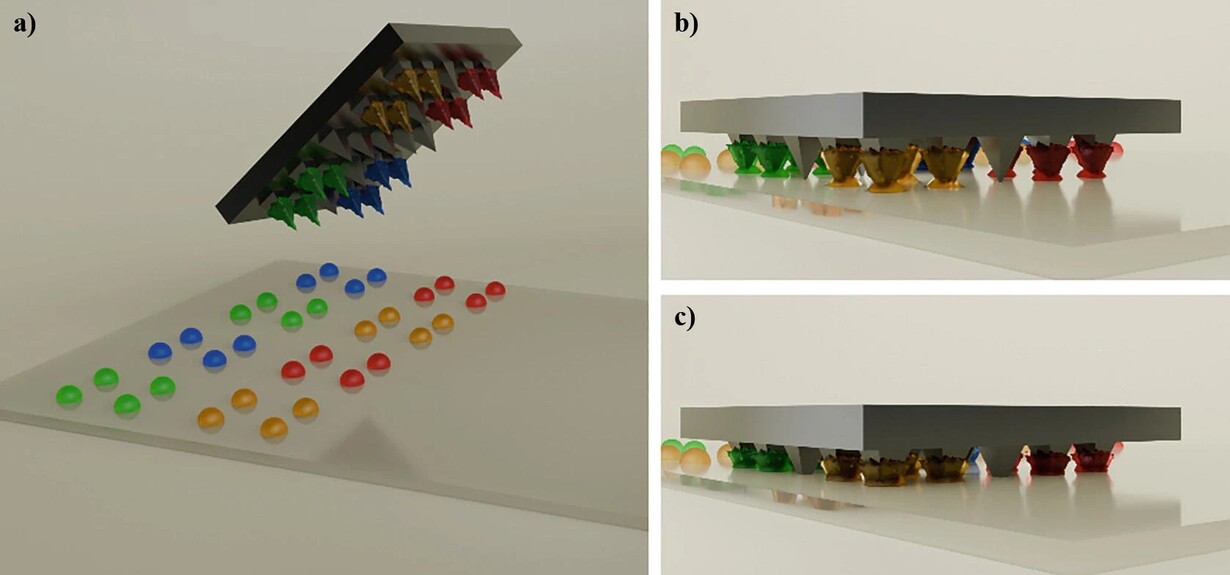
"Immunoassay Fabrication and Device Functionalization by Scanning Probe Lithography" by Vasantham et al. in Immunoassays, A. M. Raem, P. Rauch (eds.) Springer, Berlin, Heidelberg (2026) 435-447
more
"Predicting new research directions in materials science using large language models and concept graphs" by Marwitz et al. in Nat. Mach. Intell. 8 (2026) 535-544
more