
Functional Inks & Processing
Many functional materials are initially synthesized as powders or discrete particles. For their integration into electronic and electrochemical devices, however, they must be transformed into structured and electrically functional layers with controlled composition, thickness and morphology.
Our research therefore focuses on functional inks as an important link between materials synthesis and device fabrication. We investigate both nanoparticle-based inks and precursor inks and aim to understand how formulation, deposition and post-treatment determine the properties of the resulting functional films.
From Powder Materials to Functional Devices
The development of novel materials alone is not sufficient for their use in electronic devices. Active materials must be deposited in defined geometries and converted into homogeneous, reproducible and electrically accessible layers.
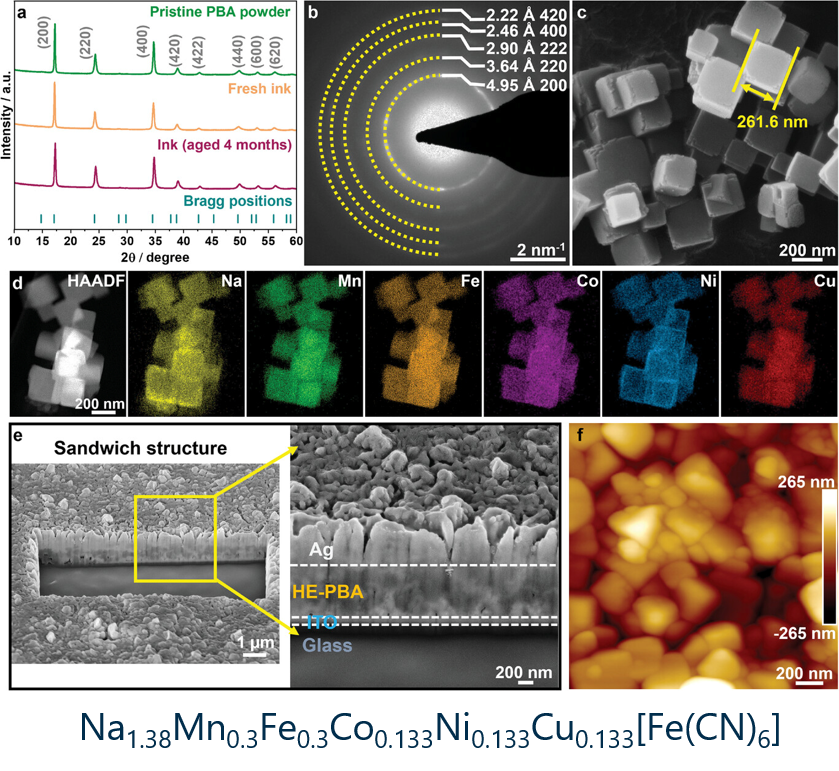
This challenge is particularly important for heterogeneous and compositionally complex material systems, for which conventional thin-film methods such as pulsed laser deposition or sputtering may not be suitable or may not preserve the desired composition and phase distribution. Solution-based processing and printing therefore provide complementary routes for transferring such materials into functional device structures.
Nanoparticle & Precursor Inks
Nanoparticle-Based Inks
Nanoparticle inks contain already formed functional materials dispersed in a liquid medium. Their processing behavior depends on parameters such as particle size, surface chemistry, concentration, solvent composition, additives and particle–particle interactions.
We investigate how these parameters influence colloidal stability, drying behavior, film formation and electrical properties. Particular interest lies in multicomponent and mixed-particle systems, where different nanoparticle populations can be combined to tune composition and functionality.
Precursor Inks
Precursor inks provide a different route to functional films. In these systems, soluble metal salts or other molecular precursors are dissolved in a suitable solvent, deposited onto the substrate and subsequently converted into the desired functional material by thermal treatment.
This approach enables homogeneous deposition from molecularly mixed solutions and can be particularly attractive for metal oxides and other inorganic materials. We study how precursor chemistry, solvent system, concentration, drying and thermal conversion influence phase formation, microstructure and final functionality.
Ink Formulation & Film Formation
Functional inks are complex material systems in which formulation and processing cannot be considered independently. Even small changes in solvent composition, concentration, additives or particle interactions can strongly affect wetting, drying, particle redistribution and film morphology.
We therefore aim to establish fundamental formulation–processing–structure–property relationships. This includes understanding how drying dynamics, substrate interactions and post-treatment govern the transition from a liquid ink to a functional solid layer.
Processing & Structuring
Printing and other solution-based deposition techniques allow functional materials to be structured directly into device-relevant geometries. These approaches enable digital patterning, efficient use of material and systematic variation of composition and processing parameters.
For highly localized patterning and device functionalization, we closely interact with the Scanning Probe Lithography for Biomaterials and Bioelectronics group of PD Dr. Dr. Michael Hirtz. Their expertise in dip-pen nanolithography, polymer pen lithography and related scanning-probe methods provides complementary routes for the spatially resolved and multiplexed deposition of functional inks.
→ Research Group Hirtz: Scanning Probe Lithography for Biomaterials and Bioelectronics
Depending on the material system, deposition is followed by drying, sintering or chemical conversion to generate the final functional layer. By controlling these steps, we investigate how processing influences connectivity, porosity, interfaces, microstructure and electrical behavior.
Multicomponent & Heterogeneous Material Systems
Solution-based processing is especially valuable for materials that contain several chemically or structurally distinct components. Such heterogeneous systems can be difficult to access using conventional vapor-phase thin-film methods.
By combining different particles, precursor solutions or functional components within a common processing route, we can investigate mixed-material and compositionally complex films while retaining a high degree of control over composition and spatial structure.
From Ink to Functionality
Our research connects ink chemistry and processing directly with the performance of the resulting material and device. Functional inks are therefore not treated merely as a deposition medium, but as an integral part of materials design.
We closely collaborate with the Printed Electronics and Circuits group of Dr. Gabriel Cadilha Marques, whose expertise in printed devices, transistor concepts and circuit design complements our materials- and ink-focused research. This interaction helps bridge functional material development with device integration and circuit-level applications.
Applications include printed electronic devices, memristive systems and electrochemical structures, where subtle differences in formulation, conversion and film formation can have a major impact on functional behavior.
→ Memristive Materials & Devices
→ High-Entropy & Compositionally Complex Materials
→ Research Group Cadilha Marques: Printed Devices & Circuits