

Research Data Management
Digitization becomes more and more important in Materials Science. For data exchange, and for reproducible experiments, metadata, describing materials, experiments, and instruments are necessary. The digitization is needed to produce data following the “FAIR” (Findable – Accessible – Interoperable – Reusable) principle. It is important to be able to track all process steps of a material, to link the steps with each other, and to organize complex research scenarios where different researchers work together using different methods to characterize a material. At the end, a holistic view of the material, its structure, morphology, and its properties should be obtained.
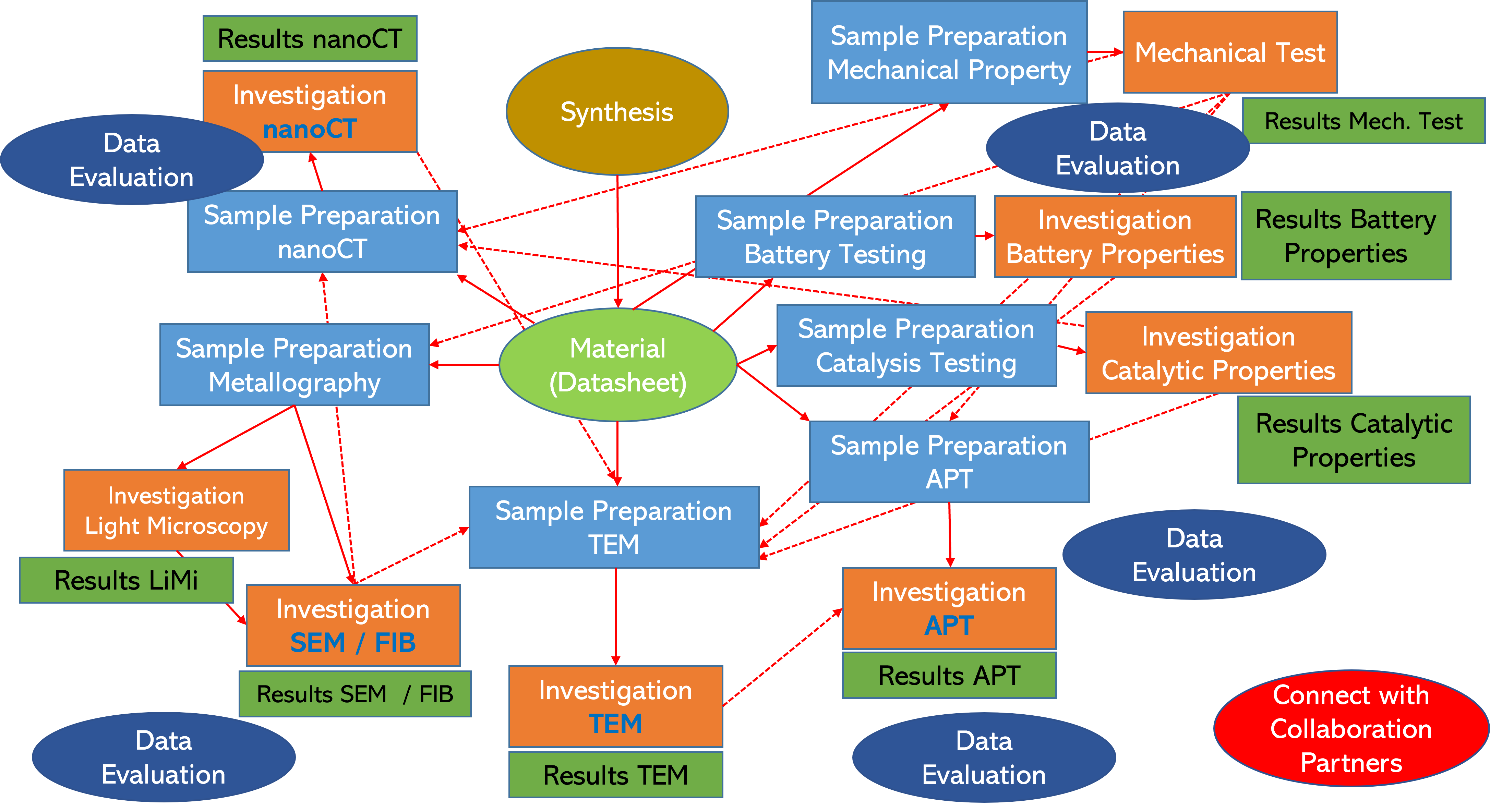
Exemplarily, the challenge of complex research scenario, applying a variety of characterization methods (e.g. chemical, structural, mechanical, physical) to one material, including the respective sample preparation steps is shown in the following image. The image is even more complex, as it does not show the documentation / history of material synthesis.
For such a research scenario, a documentation strategy for FIB / SEM / TEM-experiments, including the sometimes-needed manual sample preparation steps has been developed using an electronic lab notebook (ELN). The ELN is based on the generic and open-source virtual research environment Kadi4Mat (https://kadi.iam.kit.edu/). We developed a series of templates as blueprints, related to sample preparation and TEM/FIB/SEM- investigations, data evaluation, and sample preparation tasks. The single elements can be considered as ‘atomistic’ process steps, enabling a flexible combination of templates to generate records like in a workflow. In these records Metadata describe the experiments on the basis of Metadata schema.
Metadata are collected in one place, using a unified syntax, describing consistently the processes / experiments / steps. A dedicated right management is available to allow collaborators to access, edit, link, or manage records.
Modern scientific high-end instruments like Transmission Electron Microscopes (TEMs), Focused Ion Beam systems (FIBs), or Scanning Electron Microscopes (SEMs) are fully computer-controlled nowadays. Quite often, the instruments are equipped with additional detectors like Energy Dispersive X-ray spectrometers for EDS in TEM or SEM, Electron Energy Loss Spectrometers for EELS in TEM, Electron Backscatter Diffraction Detectors for EBSD or t-EBSD in SEM, or direct electron detectors for imaging. These scientific instruments then produce huge amounts of digital data (as images or spectra, mostly in proprietary formats defined by the instrument vendors) from all detectors and cameras, also containing metadata. The metadata describes the scientific environment and the instrument parameters used for the specific image or spectrum. Nevertheless, quite frequently, conventional sample preparation like cutting, grinding, etching, or polishing is needed before the investigation in TEM or SEM. The necessary steps are performed manually or semi-automatically, and the instruments used for these processes quite often do not deliver any metadata at all. In these cases, exact documentation of all steps and parameters is necessary to produce reliable data and results according to the FAIR-principles As a first step, all instruments have been implemented as records in an instrument database (https://www.materials.kit.edu/962.php), containing the important metadata of the instruments. These records are linked with the respective experiment done.
Exemplary overview of possible general process steps
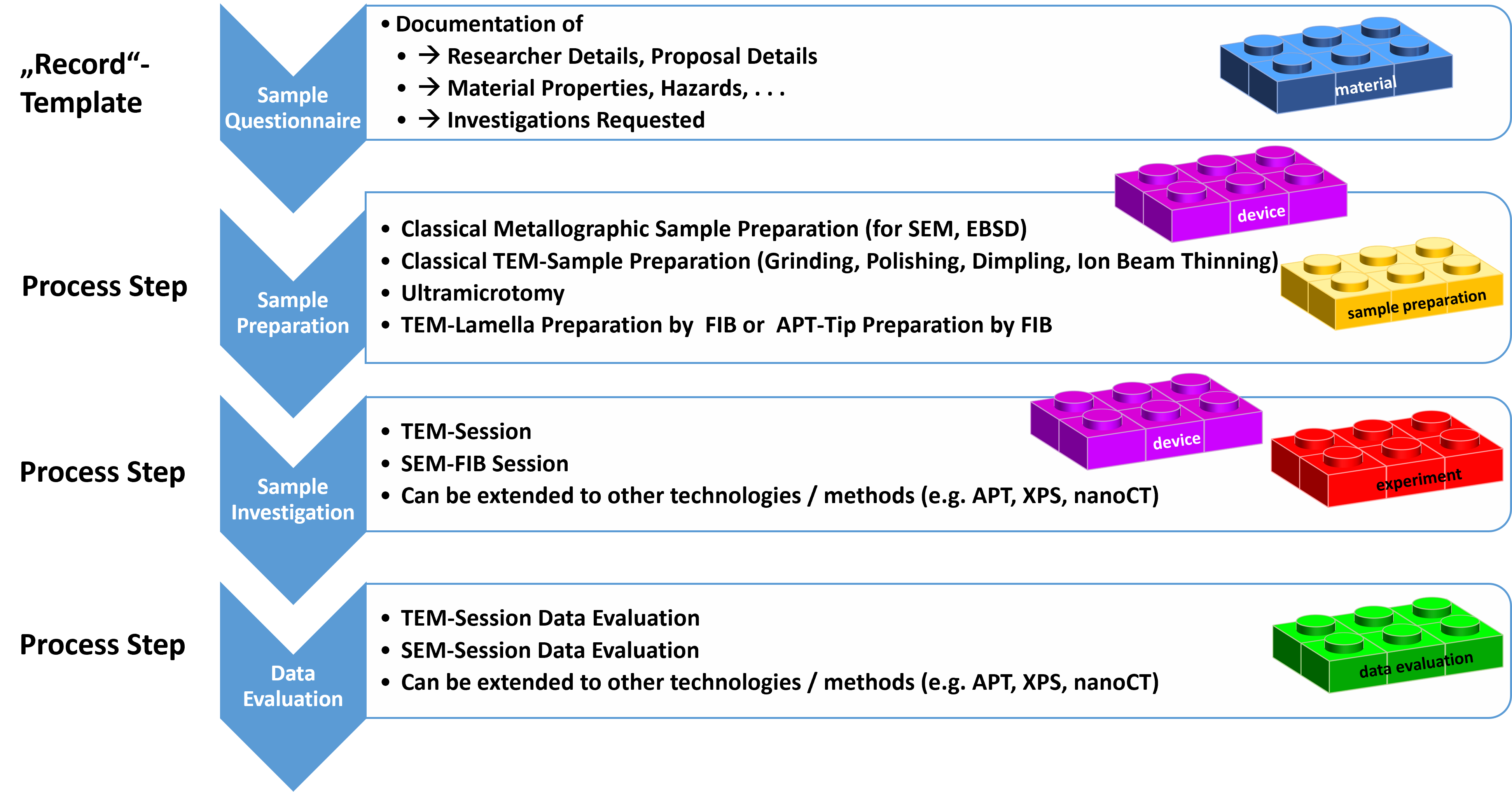
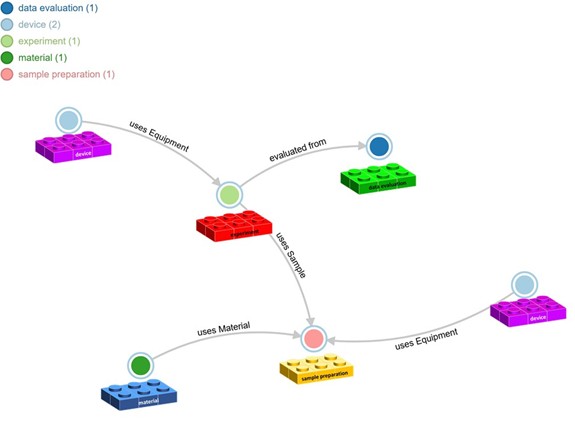
When the records for all experimental steps have been created, they are linked to each other. Thus it is possible, to track what happened to a material. As the system is modular, templates can be combined according to the needs, to create and link records. Records can be exported as JSON, RDF (TURTLE), PDF, QR-Code, or RO-Crate, supporting machine readability and interoperability.
The following figure shows a so-called “knowledge-graph”, connecting related records.
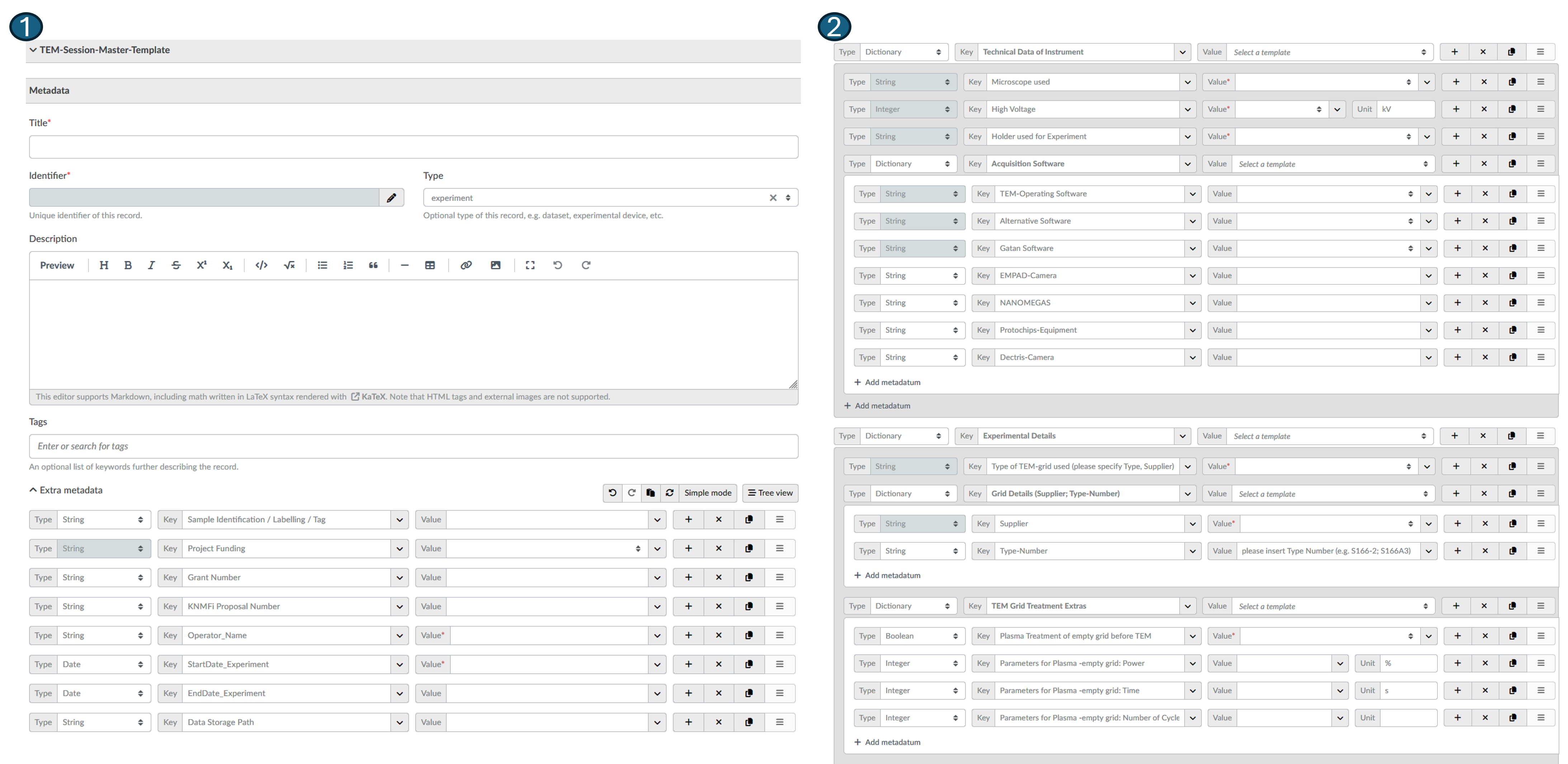
A typical record for a TEM-session requests the following input:
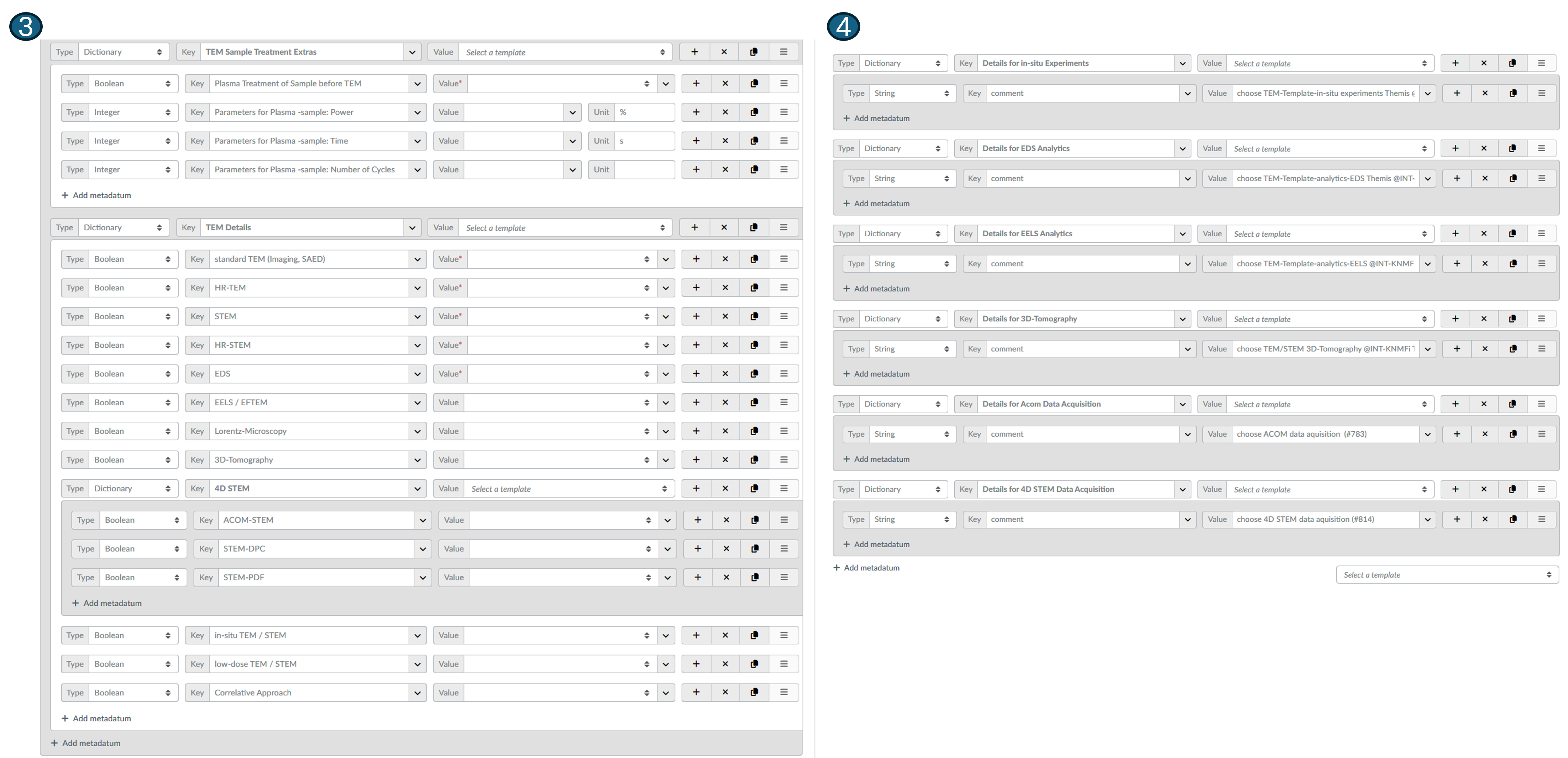
Details and further work are published at:
- S. Schlabach, J. Wild, O. Petkau, M. Selzer and D. V. Szabó: „Using ELN Functionality of Kadi4Mat (KadiWeb) in a Materials Science Case Study of a User Facility”, Data Science Journal 2024, Vol. 19, Issue 50, Pages 1-16. https://doi.org./10.5334/dsj-2024-050
- M. Jalali, M. Mail, R. Aversa and C. Kübel: „MSLE: An Ontology for Materials Science Laboratory Equipment – Large-Sale Devices for Materials Characterization“, Materials Today Communications 2023, Vol. 35, Pages 105532. https://doi.org/10.1016/j.mtcomm.2023.105532
- R. Joseph, A. Chauhan, C. Eschke, A. Z. Ihsan, M. Jalali, U. Jäntsch, N. Jung, C. N. Shyam Kumar, C. Kübel, C. Lucas, M. Mail, A. Mazilkin, C. Neidiger, M. Panighel, S. Sandfeld, R. Stotzka, R. Thelen, R. Aversa: „Metadata Schema to Support FAIR Data in Scanning Electron Microscopy”, Supplementary 23rd International Conference on Data Analytics and Management in Data Intensive Domains, DAMDID/RCDL 2021 Moscow (virtual) 2021, Pages 265-277. https://doi.org/10.5445/IR/1000141604