

Gas Environment
In situ TEM in controlled gas atmosphere enables direct observation of structural and chemical transformations at interface between solids and gases, e.g. in catalysis or hydrogen storage, but also in surface controlled solid state processes. Combination with 4D-STEM and STEM-EELS/EDX enables a fairly complete materials characterization during the transformations. In-situ electron microscopy under controlled gas atmospheres has transformed transmission electron microscopy (TEM) from a static imaging technique into a platform for dynamic materials research. By integrating sealed environmental cells and micro-electromechanical systems (MEMS)-based heating devices into the microscope, it is now possible to investigate materials under reactive gas environments while retaining nanometer-scale structural and spectroscopic resolution.

In-Situ Transmission Electron Microscopy Under Gas Environments: Hydrogen storage/release in faceted clusters
Direct Observation of Redox and Hydrogenation Processes at the Nanoscale
A representative example is the hydrogen reduction of NiO/YSZ fuel electrodes for solid oxide cells. In these systems, NiO must be reduced to metallic Ni prior to operation, and this transformation strongly affects porosity, grain connectivity, and the quality of the Ni/YSZ interface. In-situ TEM experiments conducted under hydrogen pressures between 13 kPa and 100 kPa and temperatures up to 850 °C reveal that reduction initiates preferentially at triple junctions between NiO and YSZ and at grain boundaries. The reduction front then propagates toward the interior of the grains.
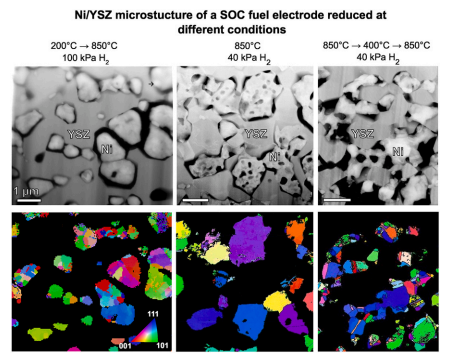
Figure 1. Formation of triple phase boundaries: In-situ TEM NiO/YSZ reduction in H2 at relevant conditions.
The reduction pathway is strongly temperature dependent. When reduction begins at moderate temperatures, large NiO grains transform into nanocrystalline Ni domains, accompanied by pore formation due to oxygen loss and volume contraction. Subsequent temperature increases promote grain coarsening and microstructural rearrangement. In contrast, when hydrogen is introduced directly at 850 °C, the reduction kinetics are extremely rapid, and individual grains preserve a single-crystalline orientation after transformation. These observations demonstrate that the initial thermal conditions determine the final Ni microstructure and the connectivity at the Ni/YSZ interface.
In addition to redox reactions at high temperature, in-situ TEM enables quantitative investigation of hydrogen absorption at moderate conditions. In palladium nanoparticles, hydrogen concentration can be determined locally by measuring the shift of the Pd bulk plasmon peak using scanning TEM combined with electron energy-loss spectroscopy (STEM-EELS). The plasmon energy decreases almost linearly with increasing hydrogen concentration, allowing calibration of the local H/Pd ratio based on simulated dielectric functions.
Isobaric experiments at hydrogen pressures of 13.3 kPa and 26.7 kPa show that hydrogenation begins at the surface of the nanoparticles and then progresses toward the core as temperature decreases. Even within the hydride phase, hydrogen distribution remains spatially inhomogeneous. During dehydrogenation, hydrogen leaves the core first, while surface regions can retain higher concentrations, leading to a clear hysteresis between absorption and desorption cycles.
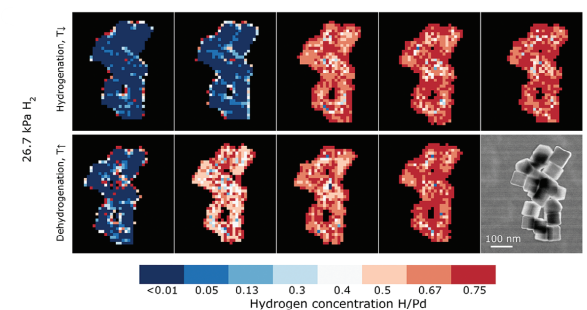
Figure 2. Isobaric series of 67 nm cubic Pd NPs hydrogenation measured at constant pressure p = 26.7 kPa. Hydrogenation presented in the upper row from left to right proceeds with the decrease of temperature. In the lower row, dehydrogenation from right to left appears with the increase in temperature.
In-situ STEM characterization of heterogeneous catalysts
Visualization of strong metal support interaction in Bimetallic PtPd nanoparticles supported on CeO2 nanocubes
In-situ (S)TEM enables the systematic investigation of the interaction of catalytic active sites with the oxide supports in heterogeneous catalysis. Strong metal support interaction (SMSI) is expected in reducible oxide supported Platinum group metal (PGM) catalysts. Bimetallic PtPd nanoparticles (NPs) supported on CeO2 cubes under strong oxidation conditions at high temperature redisperse to single sites, forming interfacial Pt-O-Ce and Pd-O-Ce bonds. Upon reduction in hydrogen atmospheres at high temperature, PtPd clusters or NPs are reformed with the reduction of oxidised Pt and Pd. The high temperature treatment damages and significantly alters the surface morphology and facet exposure of the CeO2 support as shown in HAADF-STEM images under subsequent redox conditions.
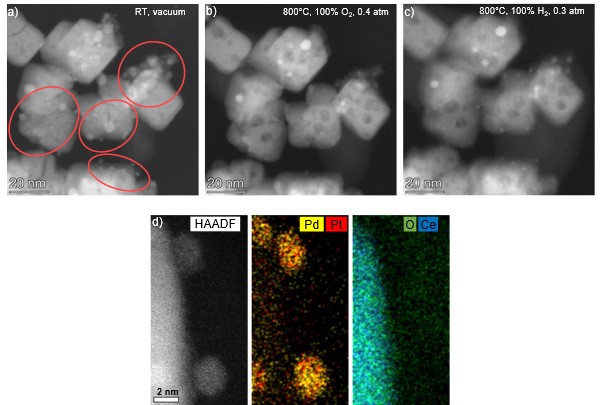
Figure 3. Bimetallic PtPd nanoparticle interaction with CeO2 under dynamic redox conditions: a) vacuum, b) strong oxidising conditions lead to the redispersion of PtPd NPs into single sites forming interfacial Pt-O-Ce and Pd-Ce-O bonds, c) reducing conditions trigger the re-agglomeration of PtPd clusters by the reduction of Pt-O-Ce and Pd-O-Ce species, and d) STEM-EDX (ex-situ) mapping of the fresh catalyst confirming the unfirm dispersion and alloyed nature of Pt & Pd on the CeO2 support.
Operando STEM characterization of Pt200 cluster on CeO2 model catalyst
In this study, Real-time operando visualization of a Pt200 on thin film CeO2 model catalyst is paired with quadrupole mass spectroscopy/ residual gas analysis (QMS/ RGA) to track catalyst structure evolution alongside catalytic performance derived from gas signals during CO oxidation. This intergrated approach tracks the Pt200 cluster dynamics and CeO2 support morphology evolution across temperature regimes in the catalytic cycle under lean reaction conditions. Correlating reactant/ product gas signals (e.g., CO2 evolution) with applied stimuli (temperature and/ or reactant gas combinations) provides direct insight into catalyst degradation, deactivation, and poisoning pathways in heterogenous catalysis.
.gif)
Figure 4. Operando STEM tracking and activity profile of Pt200/ CeO2 during CO oxidation. High-temperature imaging highlights support restructuring and cluster dynamics under operational conditions. The corresponding RGA mass spectrometry signal, plotted alongside holder temperature, demonstrates catalyst deactivation at 800 °C marked by a drop in CO2 production.
These studies illustrate the analytical capabilities of in-situ TEM under gas environments. The technique allows direct visualization of nucleation processes, phase boundary propagation, pore evolution, and spatially resolved chemical changes under realistic reaction conditions. By linking nanoscale structural evolution to gas exposure and temperature control, in-situ TEM provides experimental access to the dynamic mechanisms governing functional materials.
Details and further work are published at:
- Korneychuk, S.; Wagner, S.; Rohleder, D.; Vana, P.; Pundt, A. Local Hydrogen Concentration and Distribution in Pd Nanoparticles: An In Situ STEM‐EELS Approach. Small 2025, 21, 2407092. https://doi.org/10.1002/smll.202407092
-
Korneychuk, S.; Grosselindemann, C.; Menzler, N. H.; Weber, A.; Pundt, A. In-situ TEM Reduction of a Solid Oxide Cell with NiO/YSZ Fuel Electrode. J. Power Sources 2025, 625, 235626. https://doi.org/10.1016/j.jpowsour.2024.235626
-
A.R.L. Nilayam, R. Shadkam, H. Hahn, D. Wang, C. Kübel, to be submitted