

Quantum Materials
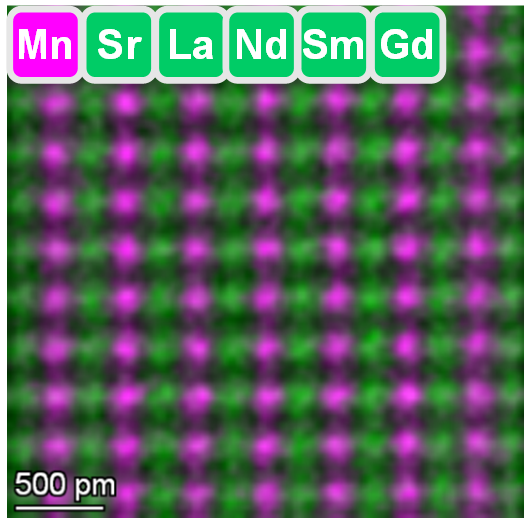
Strongly-correlated phenomena, such as, colossal magnetoresistance (CMR) and metal-insulator transitions (MIT), exhibited by perovskite manganites are accompanied and reinforced by coexistence of competing magneto-electronic phases. Such magneto-electronic inhomogeneity can be controlled by high entropy (HE) stabilized occupation of multiple-principal cations on a given sub-lattice in combination with Sr2+ (hole) doping. A series of single-phase HE-manganites, (Gd0.25La0.25Nd0.25Sm0.25)1-xSrxMnO3 (x = 0 – 0.5) were synthesized using nebulized spray pyrolysis (NSP) method. The phase homogeneity, the crystal structures, and Mn valence state were determined by high-resolution STEM and EELS for these materials. Atomic resolution imaging and spectroscopy confirmed a random distribution of the rare-earth cation and Sr on the A-site sub-lattice along with Mn on the B-site sub-lattice, without significant segregation at the atomic length scale. A strong orthorhombic distortion of the perovskite structure for x = 0 evolved towards a pseudo-cubic with increasing the Sr concentration to x = 0.5. The higher symmetric phase shows a noticeably higher density of lattice defects, including twin boundaries and Ruddlesden-Popper faults. The oxidation state of Mn has been quantified from the Mn L2,3 edges (L3/L2 ratio) and the featured maxima in O K-edge. Increasing the amount of doped Sr2+ results in change of Mn valence state from ~3.1+ for 0% Sr to ~3.6+ for 50% Sr. In addition to antiferromagnetic and ferromagnetic phase components, which mainly depend on the ratio of Mn3+ and Mn4+, HE effects play an important role in the enhanced magneto-electronic phase separation for x = 0.15 and 0.2 Sr doping, resulting in a complex magneto-electronic phase diagram with unique temperature dependencies[1].
Single-phase High Entropy Manganites


Another approach to tailor the physical properties is via interface controlled strain and charge transfer engineering in epitaxial heterostructures. In (Co0.2Cr0.2Fe0.2Mn0.2Ni0.2)3O4 HEO thin films, tensile, compressive and relaxed epitaxial strain state were generated by deposition on different substrates to control the bidirectional magnetic anisotropy. HR-STEM directly revealed the strain adaption with a two-phase structure in the thin film. EELS confirmed similar ratios of co-existing rock salt and spinel phases, where the magneto-crystalline anisotropy of the spinel-HEO can be controlled via the induced strain [2].
Proximity induced ferromagnetism in SrIrO3-LaCoO3 thin film

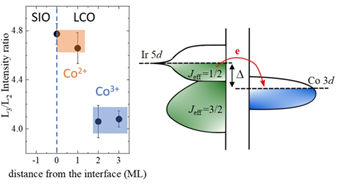
In interface engineered 5d iridates a proximity induced ferromagnetic state was achieved in perovskite SrIrO3/LaCoO3 (SIO/LCO) bilayer thin films. HR-STEM and integrated differential phase contrast (iDPC) imaging have been used to determine the crystal structure of the bilayer and to identify the IrO6 octahedra rotation in the epitaxial thin films. Atomically resolved EELS fine structure analysis has revealed a charge transfer at the interface from Ir 5d to Co 3d resulting in two well defined unit cells next to the interface with Co reduced to 2+. The observed charge transfer from the Ir is responsible for the ferromagnetism of SIO by changing the hybridization in the vicinity of the interface [3].
Details and further work are published at:
- Sarkar, A., Wang, D., Kante, M. V., Eiselt, L., Trouillet, V., Iankevich, G., Zhao, Z., Bhattacharya, S. S., Hahn, H., & Kruk, R. (2023). High entropy approach to engineer strongly correlated functionalities in manganites. Advanced Materials, 35(2), 2207436. https://doi.org/10.1002/adma.202207436
-
Zhao, Z., Jaiswal, A. K., Wang, D., Wollersen, V., Xiao, Z., Pradhan, G., Celegato, F., Tiberto, P., Szymczak, M., Dąbrowa, J., Waqar, M., Fuchs, D., Pan, X., Hahn, H., Kruk, R., & Sarkar, A. (2023). Strain-driven bidirectional spin orientation control in epitaxial high entropy oxide films. Advanced Science, 10(27), 2304038. https://doi.org/10.1002/advs.202304038
-
Jaiswal, A. K., Wang, D., Wollersen, V., Schneider, R., Le Tacon, M., & Fuchs, D. (2022). Direct observation of strong anomalous Hall effect and proximity-induced ferromagnetic state in SrIrO₃. Advanced Materials, 34(14), e2109163. https://doi.org/10.1002/adma.202109163