

Identical Location SEM/FIB Characterization
Correlating microstructural features across length scales is essential for understanding grain refinement, phase transformations, and defect evolution in severely deformed materials. Identical-location SEM/FIB/TEM characterization tracks the exact same region throughout the workflow, providing unambiguous, site-specific insight into microstructural evolution, motivating its use wherever bulk or randomly-sampled characterization cannot resolve the underlying mechanisms.
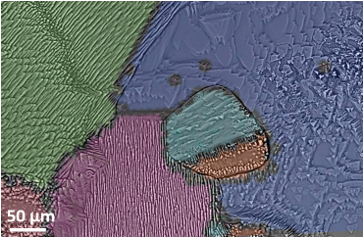
Identical location SEM-EBSD studies on Al anodes
The microstructure of electrode materials strongly influences battery performance by governing ion transport, reaction kinetics, and morphological evolution during cycling. Understanding these effects is particularly important for Al-ion batteries, where electrode stability remains a key challenge.
In this work, we investigate the deposition and stripping behavior of aluminum in symmetric Al/EMIMCl:AlCl₃/Al cells using high-purity, electropolished aluminum electrodes. To directly correlate surface changes with the underlying microstructure, electrodes are characterized before and after electrochemical cycling using identical-location SEM, backscattered electron (BSE) imaging, and EBSD orientation mapping. This approach allows us to track how individual grains evolve through deposition and stripping, revealing how crystallographic orientation and grain boundary character influence morphological changes at the electrode surface.
Our results show that aluminum stripping, rather than deposition, is the dominant driver of surface roughening during cycling. Crystallographic orientation plays a critical role in determining where and how dissolution occurs, with certain orientations showing markedly greater resistance to roughening than others.
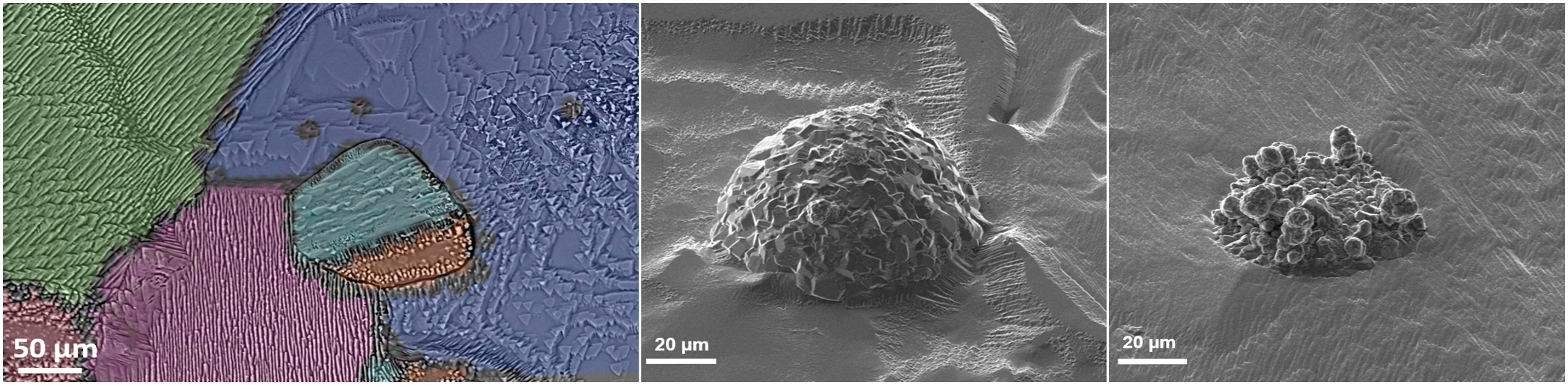
Figure 1. Left: Al electrode surface after cycling, illustrating the correlation between surface morphology and the underlying crystallographic orientation. Center and right: Two distinct types of Al dendrites formed during cycling.
These findings provide new insight into the degradation mechanisms of aluminum metal electrodes and highlight the importance of microstructural control in electrode design. Based on these preliminary results, ongoing research aims to further explore how processing conditions and microstructural engineering can be used to improve the long-term stability and cyclability of realistic Al-ion battery electrodes, contributing to the development of more durable and efficient energy storage technologies.
Details and further work are published at:
- Ahmadian, A., Velazquez, M., Kübel, C., to be submitted.